Masonry Restoration in Schenectady, NY: What Commercial & Historic Building Owners Need to Know
Schenectady carries one of the densest concentrations of late-19th and early-20th century brick and stone commercial buildings in upstate New York — and the Capital Region's harsh freeze-thaw cycles accelerate deterioration faster than owners often realize. When water enters a mortar joint, freezes, and expands, it widens the crack on the next thaw. Repeat that cycle over decades on a building that has seen deferred maintenance, and what started as a cosmetic issue becomes a structural one.
Whether you manage a downtown commercial block, a former mill building, a civic institution, or a property inside the Stockade Historic District, the decisions you make about masonry repair affect both the building's longevity and its regulatory standing. This guide walks through the warning signs, the scope distinctions, and the compliance factors that shape every restoration project in this area.
Why Are Schenectady Buildings Especially Vulnerable to Masonry Damage?
Schenectady's brick and stone facades deteriorate faster than in milder climates because water infiltration combined with repeated freeze-thaw cycles causes progressive, compounding damage that compounds with each season.
Most of the city's commercial and institutional building stock was constructed between roughly 1880 and 1940 using masonry systems that were never designed to be maintenance-free. Original lime-based mortars were intentionally softer than the surrounding brick — they acted as the sacrificial layer, absorbing movement and moisture while protecting the units themselves. Over the decades, well-meaning repairs using modern Portland cement mortars created a mismatch: the harder mortar forces stress into the brick face instead of the joint, causing spalling and face loss that is far more expensive to fix.
Efflorescence — the white, chalky salt deposits you see streaking down facades — is a visible indicator that water is moving through the masonry assembly. It is not merely cosmetic. The salts are deposited as water migrates outward and evaporates, meaning active moisture infiltration is underway somewhere in the wall system.
How Do You Know When Your Facade Needs Professional Attention?
Visible surface staining, crumbling joints, and water appearing on interior walls after rain are the clearest signs that masonry deterioration has moved past routine wear and requires a contractor evaluation.
Specific warning signs to inspect for include spalling or flaking brick faces, mortar joints that are recessed, crumbling, or missing entirely, and cracks at lintels, arches, or building corners. Rust bleeding from embedded metal anchors or shelf angles signals that embedded steel is corroding — a condition that can cause brick veneer to separate from the structure if left unaddressed. Water infiltration at window heads or on interior walls following rain indicates that the facade's waterproofing system has failed at a specific location.
Catching these conditions early changes the scope and cost of the work significantly. A building where only 10 to 15 percent of mortar joints need renewal is a repointing project. A building where lintels have deflected, units have spalled through their face, and water has reached the backup wall is a full restoration project — and the distinction matters for budgeting and permitting.
Understanding the Difference Between Repointing and Full Masonry Restoration
Repointing renews surface mortar joints when the masonry units themselves are structurally sound; full restoration is a comprehensive scope that may include unit replacement, lintel repair, crack injection, consolidant application, and structural stabilization.
Tuckpointing — the process of carefully raking out deteriorated mortar to a consistent depth and packing in new mortar that matches the original in composition, color, and profile — is the right answer when the bricks or stones are intact and the damage is limited to the joints. The critical specification detail is mortar mix design. Using a mortar that is too hard relative to the masonry units will drive future damage into the face of the brick rather than the joint.
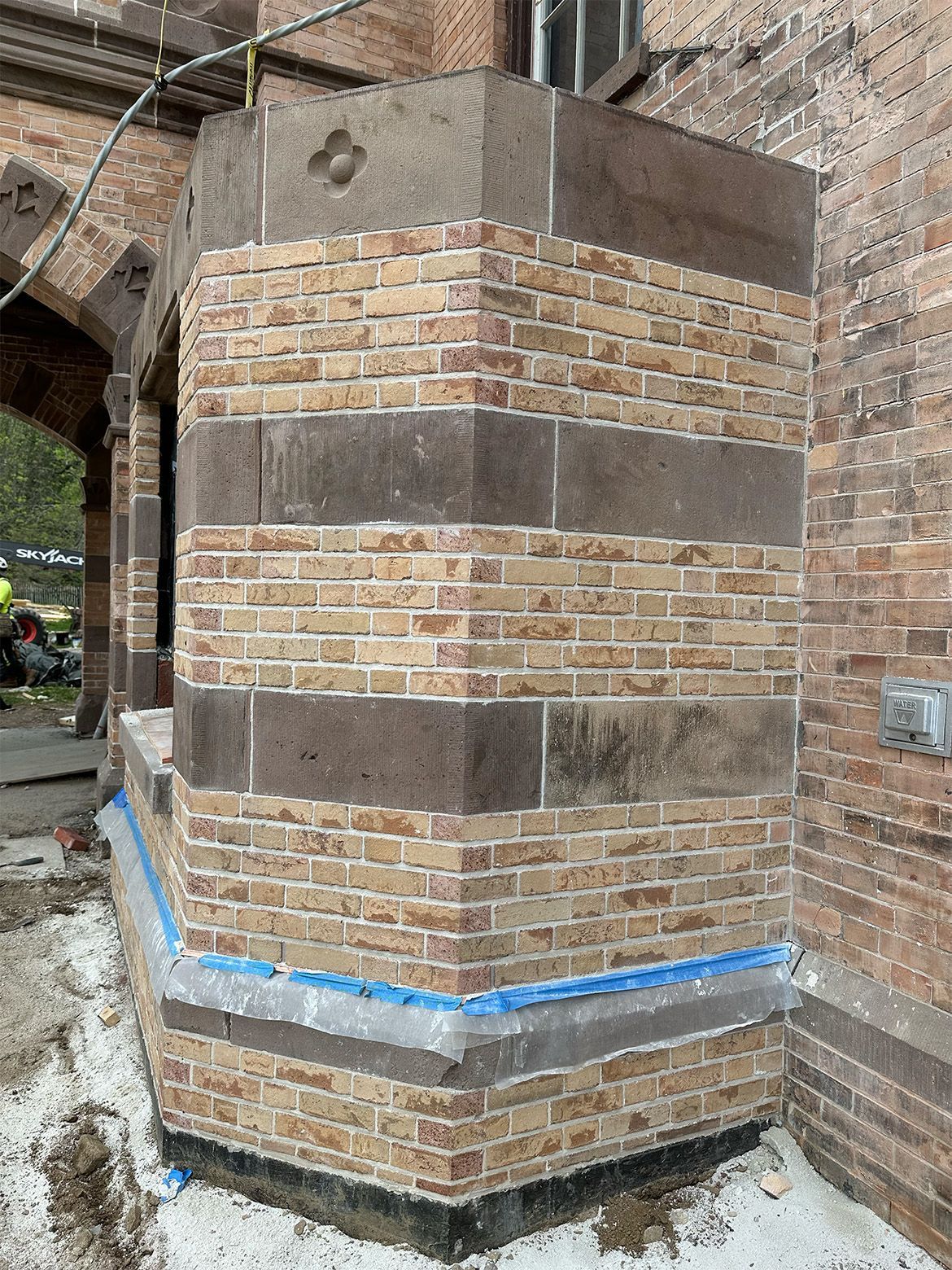
Full masonry restoration services go further: they may include selective brick or stone unit replacement to match existing material, repair or replacement of failed lintels and sills, injection of cracks with appropriate consolidants, application of surface treatments to limit future water entry, and in some cases stabilization of the underlying structure. When concrete elements — lintels, sills, copings, parking deck surfaces — are part of the scope, the work overlaps into concrete rehabilitation, which requires its own set of material specifications and inspection protocols.
How Does Historic Designation Affect Your Restoration Project?
Historic designation — whether local landmark status, National Register listing, or contributing-structure status in a district — adds material matching requirements, documentation obligations, and regulatory review steps that must be planned into the project timeline from the start.
The Schenectady Stockade Historic District is recognized as the oldest continuously inhabited neighborhood in New York State, and properties there face review under NYS OPRHP (Office of Parks, Recreation and Historic Preservation) standards. Projects on National Register-listed properties or contributing structures in a historic district must comply with the Secretary of the Interior's Standards for Rehabilitation. These standards are not suggestions — they govern what materials can be used, how cleaning methods are selected, and what repair approaches are acceptable.
Portland cement mortars, for example, are generally not approved for repointing historic brick joints without review because the compressive strength mismatch causes spalling damage to original masonry units. Lime-based mortars that approximate the original mix composition are typically required. Similarly, replacement brick must match the existing material in color, texture, size, and absorption rate — which means sourcing from specialty suppliers rather than off-the-shelf commercial brick.
The distinction between locally landmarked, National Register-listed, and contributing-structure status affects the specific review process and agency involved, but all three categories add steps that require contractor familiarity with SHPO processes and documentation standards. A contractor who has not navigated NYS OPRHP review before will slow the permitting phase considerably.
Evaluating Contractor Qualifications for This Work
Look for a contractor with documented experience on comparable building types, demonstrated familiarity with the Secretary of the Interior's Standards, verifiable NYS licensing and insurance, and a portfolio that includes work in the Capital Region on institutional, civic, or commercial structures.
Experience with public and government projects is a meaningful indicator — those projects require prequalification processes that screen contractors on financial stability, safety record, and technical capacity. Reviewing a contractor's completed projects portfolio gives you direct evidence of comparable scope and material complexity. Ask specifically whether they have worked on projects subject to OPRHP or SHPO review, and whether they can provide references from building owners or facility managers on similar work.
The ability to source period-appropriate materials — matching brick, historically accurate lime mortars, approved consolidants — is a practical capability, not just a credential. A contractor with established supplier relationships in the region can often move through the specification and procurement phase faster than one starting from scratch.
Navigating Schenectady's Climate, Permitting, and Urban Logistics
Schenectady's Capital Region climate means that project scheduling, material cure windows, and mortar application temperatures all need to be planned around the season — lime mortars in particular require protection from freezing during the curing period, which limits the practical working season for historic restoration work.
Local familiarity also reduces friction on the permitting side. Schenectady Building Department requirements, OPRHP review timelines, and urban staging logistics in a downtown setting are not generic — they are specific to this city. Contractors who have worked here understand how to coordinate scaffolding, sidewalk closures, and traffic management in a dense urban environment, and they know which permit applications require additional documentation for historic properties.
Material selection for Capital Region exposure should account for the full freeze-thaw cycle count that Schenectady sees in a typical winter. Mortar mixes, consolidants, and surface treatments that perform well in a milder climate may not hold up to the same thermal cycling, so local experience with material performance over time is a genuine technical advantage.
Addressing masonry deterioration before it reaches the structural layer is consistently less expensive than waiting — and on a historically significant building, proactive work preserves both the asset and its eligibility for preservation incentives and tax credits.
Schedule a condition assessment with PCC Contracting to determine the actual scope of your facade, get a clear picture of what the restoration process involves, and move forward with a contractor who knows Schenectady's buildings, climate, and regulatory environment.