Tuckpointing vs. Full Mortar Replacement: What Schenectady Commercial Building Owners Need to Know
When you spot crumbling or recessed mortar on your building, the repair scope you need depends on how deep the damage goes — not just how bad it looks on the surface. In Schenectady, where the Capital District averages more than 100 freeze-thaw cycles per year, a joint that looks like a surface problem in September can become a structural one by March. Knowing the difference between tuckpointing, selective repointing, and full mortar replacement before you hire anyone saves time, money, and your brick.
The Three Levels of Mortar Joint Repair
The right repair tier depends on deterioration depth and how much of the building is affected. Here is a plain-English breakdown of each level and when it applies.
Tuckpointing removes only the outermost layer of degraded mortar — typically the top half-inch to three-quarters of an inch. It is the right call when joints show surface erosion or minor weathering but the structural bond beneath is still sound. This is the least invasive option and takes days to a couple of weeks on most commercial facades. Note that many building owners use 'tuckpointing' and 'repointing' interchangeably — technically, tuckpointing is surface-depth work, while repointing goes deeper.
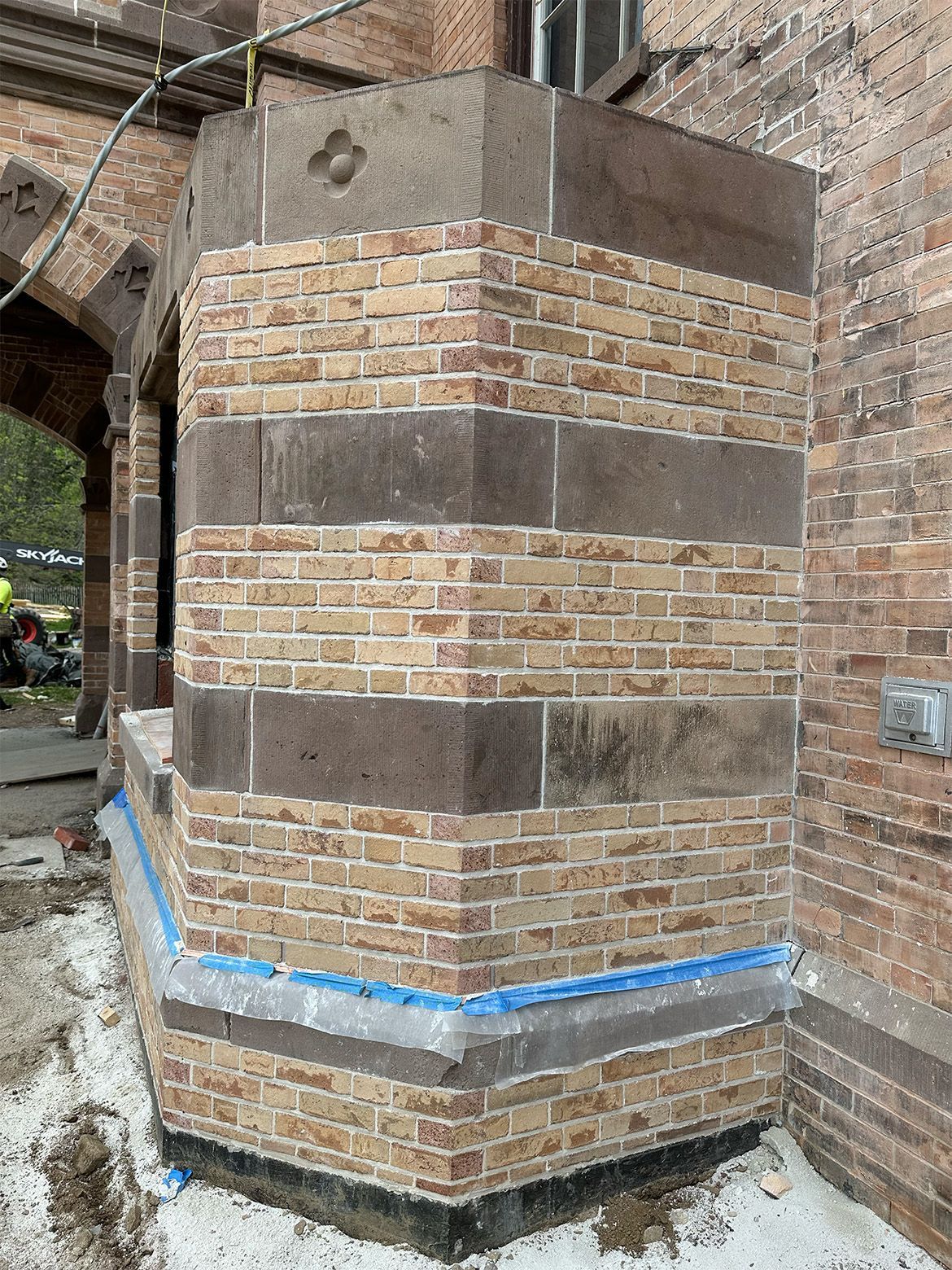
Selective repointing targets specific zones where deterioration is more advanced — window surrounds, coping joints, or elevations with recurring water infiltration. Mortar is removed to a minimum depth of three-quarters of an inch in affected areas, and new mortar is packed in. This middle tier requires careful color and mix matching so repaired sections blend with the surrounding masonry.
Full mortar replacement means every joint on a facade or the entire building is raked and repacked. This becomes necessary when more than 25–30 percent of joints are compromised, when water infiltration is widespread, or when a historic rehabilitation project demands uniform mortar performance across the whole envelope. Scaffolding, phased scheduling, and a mason experienced with historic preservation are typically required.
How to Read Your Building's Masonry
A visual self-assessment can help you arrive at a contractor conversation with a clearer picture of your repair scope.
- Surface erosion or recession of mortar — early weathering; tuckpointing is likely sufficient
- Hairline cracks along joints — thermal movement or early failure; selective repointing warranted
- Voids or missing mortar sections — moderate-to-advanced deterioration; selective to full repointing needed
- Efflorescence (white salt staining) — water moving through joints; repointing plus a drainage assessment
- Spalling brick faces — often caused by mortar that is harder than the brick, trapping moisture; full replacement with matched mortar required
- Stepped freeze-thaw cracks — water cycling through joints over winter; repointing and a structural movement check
- Loose or bulging masonry — structural bond failure; full restoration and a structural assessment are necessary
If you are seeing spalling brick faces alongside deteriorated joints, that combination is a signal that a previous repair may have used the wrong mortar — a problem common in older Schenectady commercial stock. Learn more about the full scope of masonry restoration services available for commercial buildings in the region.
Why Schenectady's Historic Buildings Demand a Different Approach
For any pre-1950s commercial building, the mortar mix specification matters as much as repair depth. Getting it wrong causes irreversible brick damage.
Historic brick — common throughout Schenectady's downtown commercial blocks, the Stockade Historic District, and early 20th-century institutional buildings — is softer and fired at lower temperatures than modern brick. The governing principle is straightforward: mortar must always be softer than the brick it bonds. When it is not, moisture that would normally escape through the mortar joints instead migrates through the brick face, causing the surface to flake and spall.
Modern Portland cement-heavy mixes (ASTM C270 Type S or Type M) are too rigid for pre-1950s brick. The correct specification for historic work is a lime-based mortar — Type O or a Natural Hydraulic Lime (NHL) formulation — matched as closely as possible to the original. On significant structures, the Secretary of the Interior's Standards for Rehabilitation require mortar compatibility testing before any repair work begins.
This is not a detail to skip. Mismatched mortar applied to historic Schenectady brick does not just fail — it accelerates deterioration of the original brick faces, turning a repointing project into a full-facade restoration. For buildings on or near the Stockade Historic District, the stakes are especially high because the district is the oldest continuously inhabited neighborhood in New York State. Institutional and government-owned buildings in the area face similar requirements — see how federal and institutional project capabilities apply to preservation-grade masonry work.
How a Professional Scope Assessment Works
A proper site assessment gives you the data to make a confident repair decision. Knowing what the process involves helps you evaluate whether a contractor is being thorough.
A qualified mason will conduct an elevation-by-elevation visual survey, mapping which zones show deterioration and what type. They will use depth sounding — tapping joints — to identify hollow or delaminated sections that are not visible on the surface. For historic buildings, mortar samples should be taken for field or lab analysis to determine the original mix before any specification is written.
The assessment should also include moisture and water infiltration mapping to identify what is driving the deterioration in the first place. A spot repair that does not address the water source will fail and spread. Finally, the percentage of compromised joints across the building is estimated — that number is what drives the scope tier and cost category.
Seasonal Timing and Capital District Weather Realities
Scheduling mortar work around Schenectady winters protects both the repair quality and your budget. Cold-weather masonry work is possible but adds cost and complexity.
Mortar requires sustained temperatures above 40°F to cure correctly — many specifications call for 50°F or higher. The Capital District's November-through-March window routinely falls below those thresholds. Work performed in cold conditions without heated enclosures can cure improperly, reducing bond strength and shortening the repair's lifespan.
The practical window for most repointing work is May through October. If you identify deterioration in late summer or fall, schedule an assessment immediately. If winter intervenes before repairs can begin, open joints should be temporarily protected — every freeze-thaw cycle in an exposed joint widens the damage and compounds the eventual cost.
When Partial Repairs Aren't Enough
Partial repairs fail — and force full restoration — under predictable circumstances that a building owner can watch for.
Tuckpointing applied over joints that are structurally failed, rather than just surface-worn, will delaminate within two to five years because the new mortar has nothing sound to bond to. Spot repointing without identifying the water source allows deterioration to continue spreading to adjacent joints. And mismatched hard mortar from a previous poor repair job can make the next round of work more expensive, not less, because the brick faces are now compromised.
Delay compounds all of these problems. Each Capital District freeze-thaw cycle in an open joint widens the damage exponentially. Commercial lenders and property insurers are also increasingly flagging unaddressed masonry deterioration during inspections, which can create financing and coverage complications on top of the physical damage.
Understanding your repair scope before you hire anyone puts you in a better position to evaluate contractor proposals, ask the right questions, and avoid paying for work that will need to be redone.
Schedule a site assessment early — ideally in late summer or early fall — so you have accurate scope and specification data in hand before the season closes.
Plan your repair scope with confidence by exploring the full range of commercial and historic masonry restoration services offered by PCC Contracting.